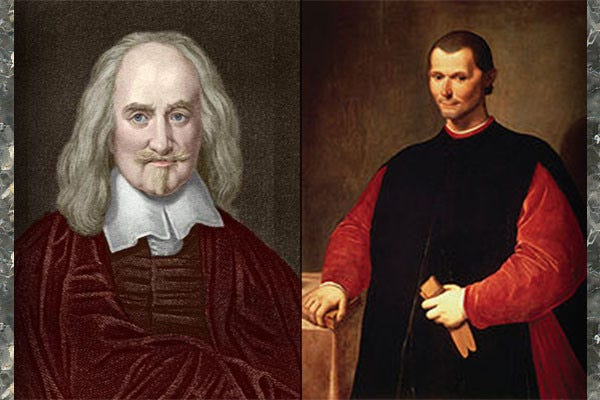
In the duration of history, many people and many rulers have used the philosophy of power politics in their pursuits of power and sovereignty. Thomas Hobbes and Machiavelli have been widely known for their literature on power politics and have influenced many people with their guidelines on forms of government that would grant someone ultimate power.
Machiavelli wrote The Prince to the Medici family in Italy to help them restore the country to its former beauty. Thomas Hobbes wrote his book Leviathan based on what form of government Hobbes concluded must be put into action if society were ever to live peacefully.
Although Machiavelli and Hobbes come from different places and different perspectives, the end result is the same and that is achieving sovereign power. Machiavelli in his pursuit of this goal comes from the perspective of the ruler and Hobbes comes from the perspective of the people and tells why the people need a ruler with sovereign authority.
In these political philosophers’ pursuits of power, they do not keep in line with a biblical view of ruler’s authority and government which is needed for a healthy and thriving society.

The first step in becoming sovereign is establishing power for yourself. Machiavelli splits forms of establishing power into two groups. The first being power that is passed down hereditarily through a bloodline, and one that is started brand new.
“All states, all dominions that have held and do hold empire over men have been and are either republics or principalities. The principalities are either hereditary, in which the bloodline of their lord has been their prince for a long time or they are new.” (Machiavelli 5).
In establishing power, a prince coming to power cannot be concerned with justice or morals and he should only be concerned with fully acquiring power. Machiavelli advises that “ one must always offend those over whom he becomes a new prince,” (Machiavelli 8). Hobbes had a different perspective on who should be in ultimate power and what mode they should use. Hobbes believed that the sovereign would establish power, be above all men, and only answer to God.
Hobbes says “ The office of the sovereign, be it a monarch or an assembly, consisteth in the end for which he was trusted with the sovereign power, namely the procurator of the safety of the people, to which he is obliged by the law of nature and to render an account thereof to God, the Author of that law, and to none but Him.” (qtd. In Smith Ch. 2).
Although Hobbes does not describe how his “Leviathan” would come to establish himself as the sovereign, it is clear that he must be over all men and his word be the absolute truth of the state. Both of these views are inherently unbiblical and heavily lack what God told rulers through the Bible. The Bible tells men to “learn to do good; seek justice, correct oppression; bring justice to the fatherless, plead the widow’s cause.” (Isa. 1:17). No man is above God’s law and what He tells man is right.
After a prince or Leviathan has established and seized power, it is time for governing and maintaining that power. Machiavelli says that to maintain power a prince must not be concerned with morality just as before.
“ I say, then, that in altogether new principalities, where there is a new prince, one encounters more or less difficulty in maintaining them according to whether the one who acquires them are more or less virtuous.” (Machiavelli 22).
Another key component in Machiavelli’s blueprint of maintaining power is having a strong army and strong laws. “ It is necessary for a prince to have good foundations for himself; … The principal foundations that all states have, new ones as well as old or mixed, are good laws and good arms.” (Machiavelli 48).
Hobbes in his ideal form of government envisioned the people of the state surrendering their right to govern themselves in the realization that men and their nature are not adequately equipped to make the best decisions for themselves. Once these liberties are surrendered they cannot be taken back or transferred.
“Having united with each other Hobbes contends men will mutually transfer all their rights and liberties in the state of nature to a third party – that is, they will surrender the ability to govern themselves to the Sovereign, and primarily out of fear.” (Levin 62-63).
After the power of the subjects is taken it is easy to maintain power because the only power left is with the Sovereign alone. The Bible clearly portrays God as the only thing anyone can look up to as an infallible standard of living and good. Man cannot depend on himself because he is inconsistent and makes errors. That’s why the only society that can truly thrive is one based upon the Lord.
In both of the examples of power politics in literature there are slightly different forms of government with the same end goal in mind; power to one individual. In Machiavelli’s government he establishes a principality in which the prince rules by his craftiness, fear, and force to keep power for himself.
“ For in truth there is no secure mode to possess them other than to ruin them. And whoever becomes patron of a city accustomed to living free and does not destroy it, should expect to be destroyed by it;” (Machiavelli 20-21).
In Hobbes’ government, the Sovereign is chosen and the subjects are convinced they are unable to govern themselves. In fear of anarchy they surrender their rights and liberties to the Sovereign. Once this happens the end goal of all power is in the hands of the Sovereign.
“ Submission to Leviathan (or Commonwealth) meant transferring one’s rights to the Sovereign. That way Hobbes believed men could live in peace, stability, and contentment.” (Levin 52).
Even Hobbes in what he thought would lead to peace and stability for mankind, he was missing something. There is no peace or good without the Lord who provides every good gift ( James 1:17), and is the embodiment of love and grace (1 John 4:8).
The only foundation firm enough for a society or even the complexities of life for the human soul to rely on is God and the words he has given man. The only infallible standard of morality and authority is the Bible which should be the base of every society and person.
Every other society not based upon these standards and a relationship with God has failed and crumbled from within. From the Caesars in Rome, to Stalin in Russia every society not based upon God and his principles will fail.
Hobbes and Machiavelli while the goal of Sovereign power was in essence the same the means were different. In Machiavelli’s principality his means justified the ends because his main priority is having power.
Hobbes however, has a view that the means justify the ends. He believes as long as the everyday life of the subject is peaceful, whatever it takes to get there does not matter. The biblical view presents the belief that both the ends and the means are important and one cannot be executed properly without the other.
In closing, a society cannot succeed unless based upon God’s words and commands, but when man tries to take over and declare himself over the authority of God, failure will come.
Sources
Machiavelli, Niccolo. The Prince. The University of Chicago Press. 1998.
The Bible. English Standard Version, Crossway, 2016.
Smith, George H. Leviathan. Narrated by Craig Deitschmann, Blackstone Audio, Inc., 2006.
Levin, Mark. Ameritopia. Threshold Editions. 2012.