“The United States will compete, and will compete vigorously… We’ll stand up for our allies and our friends and oppose attempts by stronger countries to dominate weaker ones.” The 46th President of the United States, Joe Biden, said this on September 21, 2021, during his address to the 76th session of the United Nations General Assembly in New York. Now that being said, I do not necessarily agree with the context in which he said this and the allies he hinted at supporting, not necessarily. But this is the energy we need as a Nation. America, in so many ways, has been defined as a constitutional republic that needs to seek non-interventionist policies to accomplish its goals in serving the American people. I would like to reframe the noninterventionist train of thought that so many libertarians and pacifist leftists hold on to, which views America not as the superpower of the world but as just another country. That being said, I would most certainly like to state that I am strongly against us committing acts of terrorism or invading remote countries based on foreign influence or pointless wars, such as in Iraq, Vietnam, etc. In a sense, Americans need to embrace this “New Monroe Doctrine” as a fact of reality. We as Americans need to pick ourselves up from the neoconservative Warhawk policies that have dominated the republican establishment for so long and redefine what it means to be an empire.
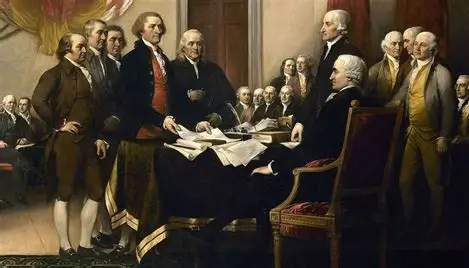
Before I give any modern examples of how America needs to be structured as an Empire, we need to go back and highlight our history as a nation. Not necessarily how we begin, but what are some demonstrations of what American exceptionalism and imperialistic thought looked like at our founding and onward? Firstly, we need to establish that Americans in themselves, even before the country was founded, were expansionists. There was a civilizational push towards imperialism present throughout not just our nation’s history, but also the Europeans who paved the way for our modern world. When it comes to having an energetic, strong central government, Alexander Hamilton said in Federalist No. 1, “The vigor of government is essential to the security of liberty.” When he uses the word vigor in this context, he is defining it as an internal and external power. You may very well disagree with Hamilton when it comes to having a powerful central government, but that is the benchmark of an expansionist American regime. You start to realize our founding fathers’ intentions, even the more anti-federalist ones, were to have a powerful nation for not only self-defense but also for self-interest. Once you put into context factors such as war debts, the size of our nation, and even the savage native Americans present how could they not have desired an imperial type of state? I could quote men such as Washington and Hamilton all day, but you might ask, what about the anti-federalists? Did they not have a great impact on our nation and warn against a powerful central government and empirically minded rule? Some of them, yes, but for the majority, most of their actions were even agrarian and to themselves had expansionistic accomplishments. Take Jefferson for an example. When you think of him, you imagine a decentralist or a John Locke phenotype who promotes states’ rights and small noninterventionist rule. His actions as president and in the government really disprove this idea. Who orchestrated the Louisiana Purchase, which was a land deal that acquired 828,000 square miles of territory from France, doubling the size of the nation and securing control of the Mississippi River…Who sent out Lewis and Clark to explore the great unknown and charter new lands? He even said himself in a letter to James Monroe in 1801, “It is impossible not to look forward to distant times, when our rapid multiplication will expand itself… over the whole northern, if not the southern continent.” He also speaks of, “An empire for liberty, as large as our continent.” In a letter to George Rogers Clark. It is undeniable that our founding fathers spoke of themes that truly did represent an empire. Theodore Roosevelt championed ideas of assertive expansionism, whether it was the construction of the Panama Canal or his fascination with explorative and scientific discoveries. I could give multiple accounts of our country’s rich history of expansion and dominating regions around us, but that is not the purpose of this article. There were always elements of a powerful American domain that took what was desirable and benefited its own people. We pioneered, we conquered, and we explored. Was this all for nothing? Shall we now just exist stagnantly? Are we going to now just to live in the greatest nation on earth and not even recognize our heritage and reciprocate those who came before us?
We could continue reminiscing and the implications of a particular president’s foreign policy. But I think there are more imperative topics than the intricacies of state Machiavellianism or federalism vs. anti-federalist to be discussed, and it was actually one of the main reasons I wrote this article. It brings us to Venezuela. If you have not heard about the conflict in Venezuela going on, you wouldn’t necessarily be living under a rock, but it would be something I would say is more pressing than the government shutdown. According to an article in Axios: “The U.S has killed at least 57 people in the Caribbean Sea and eastern Pacific Ocean in recent months with little to no oversight. A large number of warships, drones, bombers, and Marines have assembled off the Venezuelan coast, and Trump recently confirmed that the CIA is conducting covert operations targeting drug cartels in the country. Some foreign policy experts have speculated that the president may intend to topple leader Nicolas Maduro, who has a 50-million-dollar bounty on his head for his alleged involvement in drug trafficking.” Now, at face value, this seems like it could have multiple outcomes. Good ones and then more complicated ones. The more seasoned conservatives who understand the dangers of the fentanyl epidemic and drug crisis will understand, yes, we need to do whatever it takes to put a stop to the trafficking of drugs. The more hardened anti-interventionists will certainly all take a stand and say how this is “another Iraq” and Trump is “literally George W. Bush.” Even though Venezuela is certainly not the place where most drug trafficking happens, such as Mexico, Colombia, Peru, etc. I understand the concerns, but there are still other liabilities at hand. For example, Maduro is clearly a corrupt leader. It’s a dirty socialist hole in the middle of South America, which has had rampant crime and a tyrannical president since 2013. On the other hand, they are the only nation with one of the richest oil deposits that is right in our backyard. Venezuela is the largest oil reserve in the world, not some far-off country in the Middle East, such as Saudi Arabia or surrounding territories, but a small piece of land conveniently close to us. It’s a serious question that we need to ask ourselves, which is, why should we not take it? No, I am not asking for another Iraq or Afghanistan, and truly, because of the events of the past decades, I can understand the concerns. But confronting the reality that yes, we are in a way in a proxy war with Iran and on the brink of one with Russia. These countries, whether it’s Russia, China, or Iran, are allied with Venezuela, and how could the thought not come to mind, taking their land mass, extracting their oil, and toppling their oil government. We’ve done it and attempted it loads of times. Why not do it when it would be strategic to us! My point isn’t that it should be at the top of our priority list, but simply that not all interventionism and not all foreign operations aren’t America first. Especially when they pose a proximal and direct threat to our nation, which we can gain value from. Once again, I don’t desire us to carpet bomb them or have a full-scale military invasion, but a strategic deconstruction of their leadership so we can take resources.
In conclusion, I truly do believe a pro-American regime change would not only be good but beneficial to the United States, unlike the pointless regime change and wars in the middle east these past decades. It would be an actual America First strategy and a more achievable goal than Trump has envisioned, given the resources available. What matters at the end of the day isn’t necessarily their leadership, as they have always been corrupt, but rather taking their resources. The whole point of this isn’t even just about Venezuela; it’s about how Americans and policymakers have been approaching it. Because they’ve tried to make excuses on why we need regime change like “drug trafficking” or “socialism.” They can’t bring themselves to outright say, “We’re doing this to take what we want.” Because that would be totalitarian or being bullies or something like that. This nation was founded by seeing something that benefited us and taking it. I won’t apologize or try to make excuses for it because, at the end of the day, that’s what it was, and I won’t be ashamed. You can say it’s unfair or that using your power to bully people is wrong, but at the end of the day, that’s how the world has and always will work.